Insight
The Forgotten Millions: Why UK Businesses Are Left Out in the Cold When Energy Shocks Hit
How UK businesses can build energy resilience through smarter procurement, efficiency and on-site solar.
Energy
October 13, 2026
Whenever an energy crisis dominates the headlines, the pattern is entirely predictable.
Politicians line up behind podiums, news tickers broadcast emergency summits, and ministers pledge billions of pounds to protect domestic households. We see price caps, direct bill subsidies, and sweeping legislative safety nets designed to cushion voters from the shock of soaring global commodity prices.
It is easy to understand why. No government wants to oversee a domestic crisis where families face straight choices between keeping the lights on and putting food on the table.
Yet, behind the domestic headlines lies a vast, quiet section of the UK economy that experiences energy crises through a very different lens. While residential consumers receive political sympathy and structured price protection, commercial energy users are left to face the unfiltered, unforgiving realities of the wholesale market.
If you operate a business in the UK, you already know the sinking feeling of opening a commercial energy statement during a market spike. You waited for the government cavalry to arrive with an equivalent safety net.
And then you realised: in the commercial sphere, no one is coming to save you.
The Structural Divide: A Tale of Two Energy Markets
To understand why commercial consumers are left so vulnerable, it helps to examine how the UK energy system treats different classes of end-users.
For residential consumers, regulation creates a buffer between the wholesale market and the final bill. OFGEM sets price caps, and during severe market dislocations, central government intervenes with direct fiscal support to cap per-unit charges.
Commercial energy contracts, by contrast, operate under a fundamentally different philosophy: freedom of contract. In the eyes of regulators and lawmakers, a business — whether it is a multinational manufacturer or a local independent bakery — is assumed to be a sophisticated market operator capable of negotiating terms and managing financial risk.
Consider the reality for a typical mid-sized enterprise:
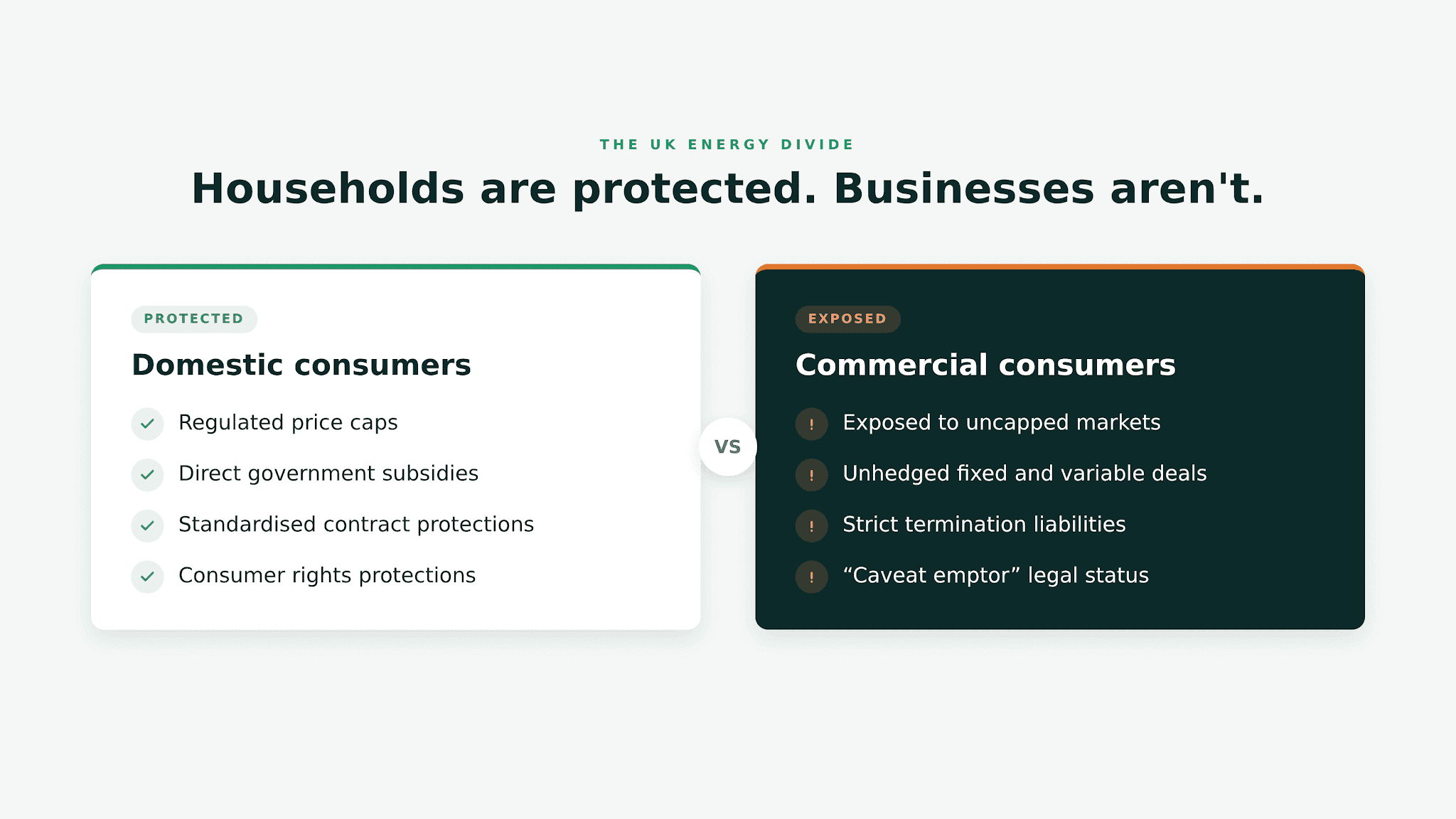
When wholesale gas and electricity prices surge, a domestic household might see its capped rate rise incrementally. But a business whose fixed-term supply agreement expires during that same window faces an immediate, binary shock. Commercial rates can double, triple, or quadruple overnight.
When a business owner calls their supplier in disbelief, expecting a consumer-style dispute mechanism or hardship fund, they are met with a polite reminder of contract law: you signed the agreement, and the rate reflects the market.
Why Government Intervention for Business Is Always Too Little, Too Late
Trade organisations and industry bodies continuously lobby Parliament for stronger commercial energy protections. During periods of extreme market stress, governments occasionally introduce temporary support schemes for non-domestic users.
However, relying on state intervention as a commercial business strategy is a fundamentally flawed approach for three core reasons:
Temporary and Conditional: Non-domestic support packages are engineered as short-term emergency measures. They feature tight eligibility criteria, strict caps on total relief, and sunset clauses designed to return businesses to market rates as quickly as possible.
Lagging Execution: Policy creation takes months. By the time a government scheme is debated, drafted, and deployed, thousands of businesses have already been forced to sign high-rate fixed contracts or drop onto punitive out-of-contract rates.
Fiscal Reality: Securing energy costs for the entire business sector requires sums that no central treasury can sustain indefinitely. The government will always prioritise voter households over corporate balance sheets.
The takeaway for business leaders is clear: commercial energy consumers are, and will remain, directly exposed to global market dynamics, supply constraints, and geopolitical shocks.
Strategic Action: Taking Control of Your Energy Bottom Line
If state intervention is off the table, how can UK businesses insulate themselves against future energy shocks? The answer lies in shifting from passive energy consumption to active operational strategy.
While wholesale commodity prices are outside your control, your exposure to them is entirely within your hands. Reducing risk comes down to three operational pillars:
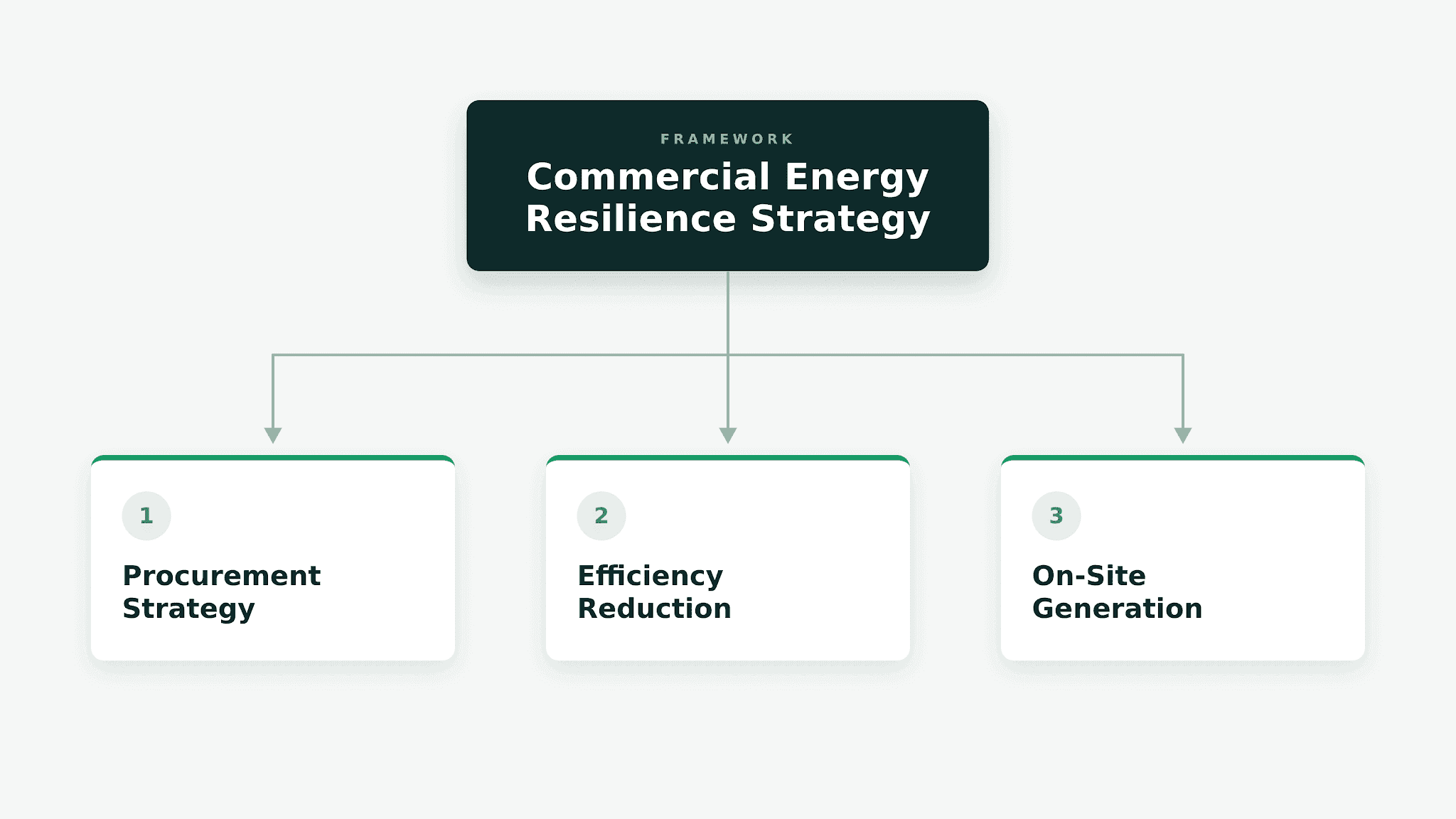
Modernise Your Procurement Approach
A surprising number of mid-market businesses treat energy procurement as an administrative task to be dealt with 30 days before a contract expires. This reactive approach exposes the business to whatever spot market price happens to prevail on that single week.
Proactive procurement involves:
Flexible Purchasing Models: Larger users can slice energy purchases into tranches across the forward curve rather than buying 100% of their volume on a single day.
Rolling Renewal Windows: Monitoring market trends 12 to 24 months ahead of contract end-dates to lock in favourable rates when dips occur.
Audit and Compliance: Ensuring standing charges, climate change levies (CCL), and network distribution fees are calculated correctly across multi-site portfolios.
Attack Baseload Waste
The most cost-effective kilowatt-hour is the one your facility never consumes. Significant reductions in energy spend do not require shutting down operations; they require eliminating invisible waste.
Plug-Load Management: In commercial office spaces and light industrial sites, up to 40% of electricity consumption comes from socket loads. A substantial fraction of this power is consumed outside operating hours by equipment left in standby mode. Automated power management and smart control systems ensure non-essential loads are isolated when facilities are unoccupied.
Voltage Optimisation: Standard UK grid distribution often supplies voltage higher than modern electrical equipment requires to operate efficiently. Installing voltage optimisation equipment regulates incoming supply to optimal levels, reducing total kilowatt-hour consumption and extending equipment lifespan.
HVAC and Automation Controls: Fine-tuning building management systems (BMS), upgrading to LED lighting arrays, and sealing thermal losses yield immediate, compounding reductions in base energy demand.
Deploy On-Site Generation and Storage
Generating power at the point of use directly reduces the volume of grid electricity a business must purchase at market rates.
Commercial roof space, car parks, and unused land represent unexploited energy assets. Rooftop solar photovoltaic (PV) arrays allow businesses to generate clean power at a predictable, fixed cost per unit for decades.
For organisations seeking to avoid upfront capital expenditure, structures such as Power Purchase Agreements (PPAs) or funded installations enable businesses to install solar infrastructure with zero capital outlay. Under these agreements, the business simply purchases the solar electricity generated on its own roof at a discounted, fixed rate that remains insulated from wholesale market volatility.
Building a Market-Resilient Business
Energy pricing is no longer merely an overhead line item to be paid without question; it is a strategic variable that directly impacts gross margins, operational competitiveness, and long-term business viability.
While the domestic space will continue to occupy the centre of political debate and emergency policy, commercial operators must navigate the market with clear-eyed self- reliance.
Businesses that build energy resilience today—by optimising procurement, eliminating structural waste, and generating power on-site—will not only survive the next market shock, but will outcompete those still waiting for a government bailout that isn’t coming.